Welcome to Cosmopedia
Background
Cosmopedia began when our first son (yes, his name is in fact Cosmo) was 6 months old, as a series of laminated one foot square cards, held together by cable ties. The initial inspiration had been a family history of dyslexia and a desire to encourage an early familiarity with the written word. We still use this hard copy version with our younger son and consider that for early years it is more appropriate.
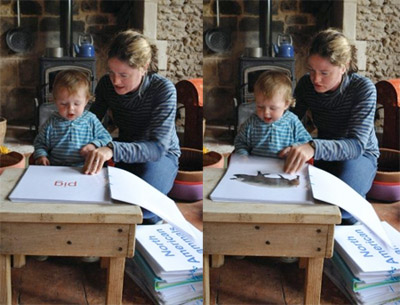
By eighteen months Cosmo was able to identify several words, including when scrawled in different contexts, such as on blackboard. And so in some ways he appeared to be progressing. The odd and uncomfortable thing that we successfully ignored for a while was that he was not yet talking. At his two year check-up many additional “red flags” were identified, setting us on a path that was to eventually lead to a diagnosis of autism. Over such time everything changed as we tried to turn around every area of our lives to prioritise his needs.
After a very encouraging two years at pre-school with some wonderful support things went terribly awry during a disastrous term and a half at the local primary. All progress that had been made went into reverse, the “red flag” behaviours returned, Cosmo became introverted, and what speech he had worked so hard to develop began to disappear. We pulled him out and switched to combination of home educating and part-time at a Steiner-based school.
Interestingly, his Statement of Special Needs noted back then that whole-word recognition would possibly be preferable over phonics for Cosmo, due to the literality of his thinking. So after over three years of flash cards we had some indication that we had been on the right path all along, also confirmed when professionals began to introduce visual aids such as “Now and Next” boards, “Traffic Lights” and PECS. We now feel that though the original intention had been to encourage reading skills, the benefit has ultimately been something more.
We can only guess to what extent the flashcard system helped Cosmo find his way into the world, or indeed verify the efficacy of any of the many other adaptations we undertook, be they dietary, environmental, therapeutical or educational…but that’s another story. He is now undeniably very high-functioning. There have been many points on the journey where it has been very clear that things could have so easily gone another way.
Certainly many of his first words were from the flash cards, possibly because they were read to him at close physical range, thus cutting through the confusions of his world. With the realisation of his condition we were determined to do everything that we could, and continuing with what had already been successful was clearly going to be anything but deleterious, hence the system that you now find here.
Creating an online version became the logical next step. For one thing, we were runnning out of room with stacks of flash cards piling up! The early version was in Flash, but then the iPad & iPhone platforms became ubiquitous, so now everything runs in HTML and CSS with liberal applications of JQuery.
We can be comparatively relaxed with our second son, as he is another kettle of monkeys all together and much of his development seems by contrast to be happening somewhat automatically. In fact after our experiences with Cosmo, neurotypical language acquisition can appear like a kind of magic. Yet Ptolemy loves and benefits from our creation just as much, and we are content that Cosmopedia has a more general use beyond the original grounds.
How to Use
Cosmopedia is comprised of sets. These are categories of mainly nouns, containing around ten per set. Where possible, the images are discrete. I admit that I gave up cutting out the backgrounds somewhere between North and South America.
Cosmopedia is - so far - designed to be used under adult supervision. Our children often like to choose a set themselves. We then decide which mode would be more appropriate to explore the subject, according to the difficulty of the words within the chosen category. Generally for the very young or when a set is new, we start with Slideshow.
As Cosmopedia was created for our own use, I have not as yet provided any indication of word difficulty for each set, though I appreciate that this would be useful to others. Generally however it should be obvious that Farmyard Animals may be a better pathway to Test Mode than, say, Dinosaurs. Taking a little time to familiarise yourself with the various sets will help.
The Modes
Slideshow
Is the original, standard or “classic” mode, a straight adaptation of how we used the physical version. The words were presented separate from the pictures, and would be read as enthusiastically as possible (not always easy for stressed parents, I’ll grant) and with altering tone for variety and interest.
You may feel it is a little fast. We have tinkered with the speeds for years and found that the little ones can take it all in at quite a rapid pace. In fact one of the reasons that we switched from the physical version is that we found that we couldn’t turn the pages fast enough! One may however adjust the speed, and order. There is also an inbuilt algorithm that calculates variable slide durations according to word length, so you do get a few more tenths of a second to say ‘Ankylosaurus’.
As Cosmo grew older we began to adjust and extend the system around him, adding the modes below.
Test
In this mode, one can select three words + one picture or vice versa. Either way encourages the child to make leaps of intuition when reading. We feel that this is a useful adjunct to phonics.
Those beginning to read will find either mode fun, and even younger users can be led in the three pictures form. For example, you may say “This word is ‘apple’. Is the apple on the left, right, or middle?” This has led to the unplanned bonus of helping Cosmo with his right/left confusion.
(Actually, the term “test” doesn't quite sit comfortably, as the point here is not to measure ability but to encourage development. We toyed with “game” for a while but that doesn't quite fit either. Suggestions welcome.)
Browse
As Cosmo finally began to talk and became capable of conversation, we figured it was time to alter the system again. Now we can flip back and forth through the slides, discussing whatever arises. Concepts such as classification are naturally taking shape.
The most recent adjustment has been to allow pictures and words to be presented separately in Browse mode, as Cosmo is now confident enough to have a stab at reading words “blind”, a progression from the assistance afforded by Test mode. When forwarding to the next slide to see if his guess had been correct, his pride at having read the word without any visual clues is clear.